
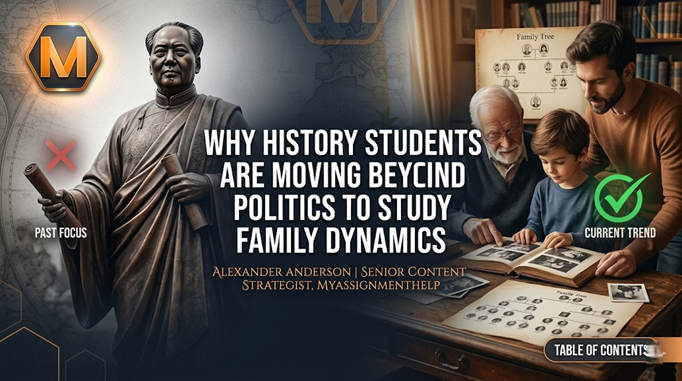
The study of history has long been dominated by the “Great Man” theory—a focus on kings, presidents, and generals who shaped nations through wars and treaties. However, a significant shift is occurring in lecture halls and research libraries across the globe. Today’s undergraduate students are increasingly turning away from traditional political timelines to explore the intricate, messy, and deeply human world of family dynamics. This transition reflects a broader desire to understand how the “average” person lived, loved, and survived, moving the historical lens from the palace balcony down to the kitchen table.
For many students, this shift isn’t just a matter of interest; it’s a matter of academic survival. Navigating the transition from memorizing dates to analyzing complex social structures requires a new set of skills. When the volume of primary sources—like old census records or private letters—becomes overwhelming, many find that seeking professional history essay help is a practical way to master the methodology required for high-level historical analysis. This specialized support allows students to focus on the narrative of the past while ensuring their technical arguments meet rigorous university standards.
The Decline of the “Great Man” Narrative
For decades, political history was the undisputed king of the curriculum. It provided a clear, linear progression of events: a law was passed, a war was fought, a border was moved. But this top-down approach often leaves out 99% of the population. Modern students are asking different questions. They don’t just want to know who won the Battle of Waterloo; they want to know what happened to the families left behind, how widowhood affected local economies, and how the concept of “childhood” changed in the wake of the Industrial Revolution.
This “History from Below” movement has gained momentum because it feels more relevant to our contemporary lives. In a world where personal identity and social justice are at the forefront of public discourse, looking at how families functioned in the past provides a mirror to our own societal structures. It turns history from a list of distant facts into a lived experience that students can relate to on a personal level.
The Rise of Micro-History
Micro-history is the tool that has made the study of family dynamics so compelling. By focusing on a single small village, a specific household, or even a bundle of recovered letters, historians can reconstruct entire worlds. This granular focus reveals truths that macro-politics often obscures. For example, while a political history might describe the 1920s as a “roaring” era of prosperity, a micro-history of a working-class family might reveal a much more nuanced struggle with urban poverty and shifting gender roles.
This approach requires students to be part historian and part sociologist. It demands an understanding of “Information Gain”—finding the unique story that hasn’t been told a thousand times before. By digging into the domestic sphere, students are finding fresh “Information Gain” that makes their research stand out to professors and peer-reviewers alike.
Academic Trends: Why Families Matter Now
Several factors are driving the popularity of domestic history in universities today:
- Interdisciplinary Learning: History is no longer a silo. It now intersects with psychology, economics, and gender studies.
- Digital Archives: Digitized parish records and ancestry databases have made family-level data more accessible than ever before.
- Cultural Empathy: There is a growing academic interest in the history of emotions—how people felt, rather than just what they did.
| Historical Focus | Traditional (Political) | Modern (Social/Family) |
| Primary Subject | Heads of State | Ordinary Households |
| Core Source | Official Treaties/Laws | Diaries, Letters, Wills |
| Key Goal | Understanding Power | Understanding Experience |
| Student Appeal | Strategic/Linear | Relatable/Nuanced |
Bridging the Gap: From Theory to the Page
Transitioning from broad historical themes to a specific, gradable essay is the biggest challenge for the modern student. Selecting a topic that is narrow enough to be manageable but broad enough to be significant is an art form. When brainstorming for a term paper, looking at a curated list of family essay topics can provide the necessary spark. At MyAssignmentHelp, the focus is on helping students connect these domestic themes to larger historical shifts, ensuring that a paper on 19th-century parenting, for example, also addresses the broader economic changes of the era.
By using these targeted topics, students can avoid the “red flags” of generic writing. A paper that explores “The Impact of the Great Depression on Appalachian Family Structures” is infinitely more valuable—and more likely to rank well in academic databases—than a broad overview of 1930s economics. It shows that the student has moved beyond the “what” and is now investigating the “why.”
The Methodology of Domestic Research
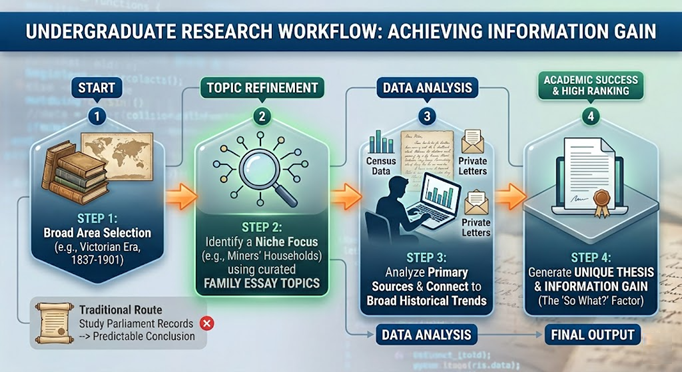
To write a high-ranking history paper on family dynamics, students must master three specific techniques:
- Triangulation of Sources: Don’t just rely on one diary. Compare that diary with local economic records and legal documents from the same period to see if the personal experience matches the public record.
- Contextualization: A family does not exist in a vacuum. You must explain how national events (like a famine or a new tax law) physically changed the way that family interacted with one another.
- The “So What?” Factor: Always bring the research back to a larger point. If you are writing about the evolution of the nuclear family, explain how that evolution influenced modern housing or labor laws.
Global Perspectives on the Domestic Sphere
This isn’t just a Western trend. In universities across Asia, Africa, and South America, students are using family history to decolonize the narrative. By looking at how indigenous family structures resisted or adapted to colonial rule, researchers are uncovering a hidden layer of resistance that political history completely missed. This global shift ensures that history remains a dynamic, evolving field rather than a static collection of national myths.
Conclusion: The Future of the Past
The move toward studying family dynamics represents a maturing of the historical discipline. It acknowledges that the private lives of individuals are just as influential as the public acts of leaders. For the undergraduate student, this provides a golden opportunity to produce original, engaging work that contributes to our collective understanding of the human journey. As we continue to digitize our past, the stories of the family will only become more central to how we define our history.
Frequently Asked Questions (FAQ)
1. Why is social history considered more difficult than political history?
Ans: Social history requires synthesizing “unstructured” data like letters and oral traditions, which can be harder to verify than official government documents. It requires a high level of critical thinking to interpret emotional subtext.
2. How do I find primary sources for family history?
Ans: Start with digital archives like the National Archives (UK/US), search for digitized local newspapers, or look into university library collections that specialize in “Special Collections” and private manuscripts.
3. Can I combine political and family history in one essay?
Ans: Absolutely. In fact, the best essays often show how a political event (like the passing of the 19th Amendment) directly changed the power dynamics within a specific type of household.
4. What are some common “red flags” in history essays?
Ans: Generalizations (using words like “always” or “everyone”), failing to cite primary sources, and “presentism”—the mistake of judging people from the past by modern-day moral standards.
5. How long should a comprehensive history research paper be?
Ans: For undergraduate levels, they typically range from 2,000 to 3,500 words, though guest posts and summaries are usually shorter (1,200–1,500 words) to maintain online engagement.
About The Author
I am Alexander Anderson, a Senior Content Strategist at MyAssignmentHelp, where I specialize in helping students bridge the gap between complex academic theory and high-quality research output.